The measure of how high the stock of the Aberdeen manager’s job had risen
since the last time it fell vacant in 1924 was evident in late 1938 by the sheer
volume of applicants seeking to replace the Shawfield-bound Pat Travers. After
due consideration – a process that took five weeks – the Aberdeen
board finally settled on a relatively unknown candidate Dave Halliday, and accordingly
he was announced as the new manager on 22 December 1937.
Born in Dumfries, Halliday, like his predecessor Travers, enjoyed a long and
varied career as a player and it was probably that factor which won him the
job ahead of nearly 100 other hopefuls. His football career began in local
schools soccer in the Dumfries area, where he featured on the left wing. Local
League side Queen of the South picked him up when he was old enough but after
a short spell with the “Doonhammers” he joined St Mirren where
he featured in the reserve side at inside left. Later he was transferred to
Dundee, and the move to Dens Park proved to be the making of Dave Halliday
as a player. The Dark Blues converted Dave to a centre-forward and the Dens
Parkers reaped the benefit to the tune of 100 goals in four seasons. Halliday’s
goal scoring exploits earned him a Scottish League cap against the English
at Ibrox in 1924. Dave moved on from Dundee to Sunderland, and after a spell
at Roker Park, was transferred to Arsenal for £6,500 in November 1929.
The following year Halliday was on the move again, this time to Manchester
City for a fee of £5,700.
Dave’s first move into management happened in the mid-1930s when he
took over non-league side Yeovil and Petters United as player manager. He was
still with the West Country side when he applied for the vacant Aberdeen job
in November 1938. Halliday took up his duties at Pittodrie early in the New
Year of 1938 and he could have hardly picked a more inopportune time to move
into management. Pat Travers had already begun to dismantle his superb mid-1930s
Black & Gold side and had not finished rebuilding when he departed for
Shawfield. As a result, Halliday’s early days at Pittodrie were punctuated
by new signings, many – like former Yeovil player Charlie Smith – from
unfashionable English clubs, but the acquisition of George Hamilton, a lad
from Halliday’s native Dumfries, at the tail end of the 1937-38 season
proved to be as shrewd a signing as he would ever make.
During Halliday’s first season and a half in charge, a new Dons team
began to emerge and Halliday’s Dons, now changed from the old black a
gold colours to red and white, reached a Scottish Cup semi-final, where they
lost 3-1 to Motherwell after a replay. Any chance Halliday had to build on
that last four appearances disappeared after World War Two broke out in September
1939. Directors Charles B Forbes and George Anderson, both former players,
took over the management reigns while Dave Halliday did his bit for the war
effort, but thankfully the basic fabric of the immediate pre-war side was still
around when the boss returned to resume his duties at Pittodrie.
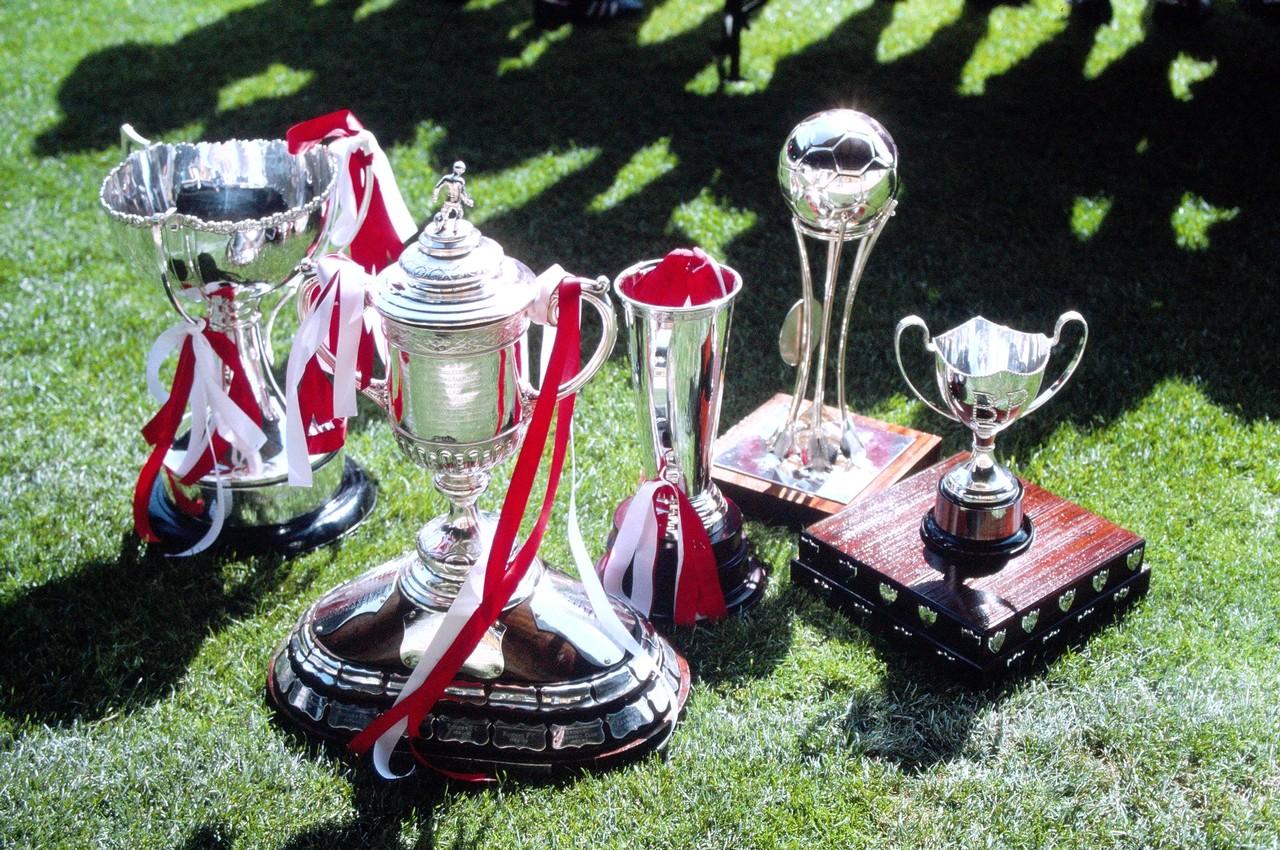
The 1945-46 Southern League Cup competition – on paper a war trophy,
but in reality a full blown fore-runner for the League Cup competition itself – Saw
Halliday’s Dons march to a Hampden final appearance against the mighty
Rangers. On a memorable spring afternoon Aberdeen came of age, winning a thrilling
game 3-2 and thus securing Dave Halliday’s place in the Aberdeen Hall
of Fame as the first manager to bring a national trophy to Pittodrie. The following
year the Dons were back at Hampden in both the League Cup final, which they
lost 4-0 to Rangers, and in the Scottish Cup final itself. In another memorable
tussle Aberdeen took the honours with a fine 2-1 win over Hibs inspired by
none other than George Hamilton, the Dumfries lad that Halliday had brought
to Pittodrie back in 1938.
Incredibly, at only the third attempt, Dave Halliday had guided the Dons to
the prize that had so often eluded excellent Aberdeen sides under his predecessors.
Not surprisingly, with a side containing many pre-war names, Halliday was faced
with another rebuilding job within months of the Scottish Cup triumph. After
two seasons spent flirting with relegation, the manager had assembled a new-look
side that went on to lose successive Scottish cup finals in 1953 and 1954,
before realising their full potential and landing the ultimate prize itself,
the Scottish League Championship in 1955. The championship trophy had hardly
time to gather dust in the Pittodrie boardroom before Leicester City had tempted
Dave Halliday to take over at Filbert Street. During his tenure at Pittodrie,
manager Halliday, like Philip and Travers before him, was never involved in
training methods. Donald Colman, Bob McDermid, Jock Pattillo and Dave Shaw
were the men who served him in that capacity. At Leicester, Halliday guided
City to the First Division in his second season in charge, but met with mixed
fortunes thereafter. He died in 1970.
|